Guardlocking vs. interlockingWhen do you need what?
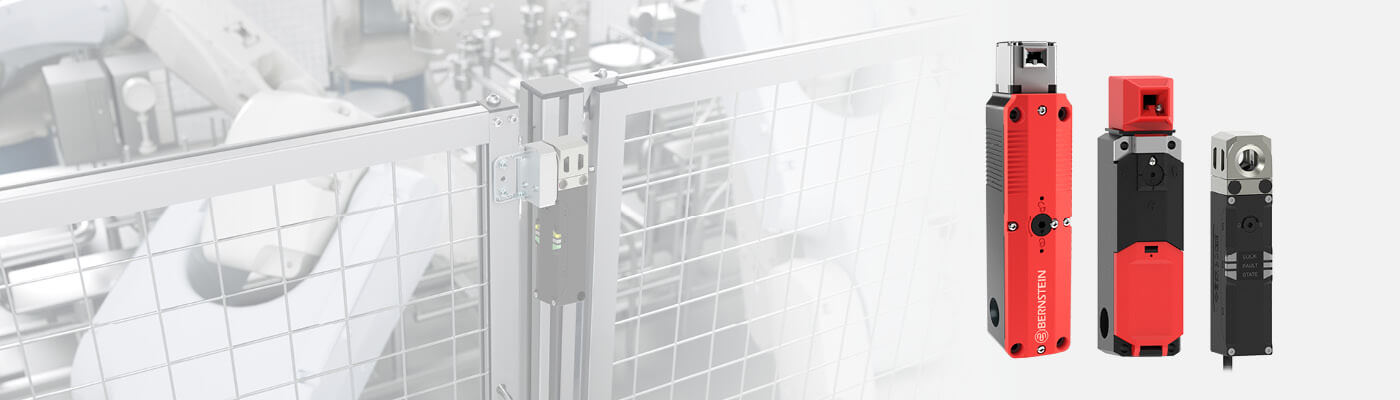
When is a locking mechanism sufficient, and when is an interlock required? This question repeatedly causes uncertainty in practice. This is hardly surprising, as both systems monitor safety doors and make an important contribution to machine safety – yet their functions differ significantly. In this article, we explain the key differences, show you what to look for when making a choice, and provide clear guidance on their correct use.
Guardlocking or interlockingWhy are these terms so often confused?
Anyone involved in machine safety will, sooner or later, come across the terms ‘safety interlock’ and ‘safety guard interlock’. In everyday language, they are often used interchangeably; from a technical perspective, however, they fulfil different functions. Both systems monitor safety doors or movable safety guards and contribute to machine safety.
The key difference, however, lies in when they provide protection. Choosing the right system is therefore not merely a technical decision. It has a direct impact on the safety of operators, maintenance staff and service engineers, and is an important component of machine design that complies with standards.
What is a safety lock?
A safety interlock monitors the status of a safety door or safety guard. As long as the door is closed, the safety switch transmits a signal. If the door is opened, the switch interrupts this signal and the machine is stopped or brought to a safe state. It is then ‘locked’ to prevent it from restarting.
The aim is simple:
- Dangerous movements must only be possible when the protective device is closed.
- When the guard is opened, the machine is safely shut down.
What is a safety switch with guard locking?
A safety switch with guard locking combines the safety lock with an additional interlocking function. It not only prevents operation whilst the door is open, but also ensures that the safety door cannot be opened until the hazard has been eliminated. This prevents people from entering a hazardous area prematurely.
Why is a lock-out sometimes not sufficient?
Many machines do not come to a complete standstill immediately after being switched off. Typical examples include:
- heavy flywheels,
- rotating tools,
- hot tools,
- residual pneumatic or hydraulic energy.
If the safety door could be opened immediately, people could still be exposed to significant hazards even though the machine has been switched off. A safety interlock is designed precisely for these situations, where the machine has a dangerous inertia.
An overview of the key differences
| Feature | Safety interlock | Safety switch with guard locking |
| Main objective | Stop the machine | Stop the machine and keep the door closed |
| Time of protection | When the safety door is opened | Before and after opening |
| Door opening | Possible at any time | Only after safe authorisation |
| Protection against over-travel | No | Yes |
| Typical hazard | Eliminated immediately | Persists after switch-off |
| Typical machinery | Conveyor technology, assembly lines | CNC, robotics, presses, machining centres |
When is an interlock required?
Whether a safety switch with guard locking is required depends on the risk assessment carried out for the machine. As a general rule, whenever a hazard persists after the machine has been switched off, the safety door should remain closed until a safe condition has been restored.
High temperatures
Not every hazard is caused by movement. Hot tools or heated equipment can also cause injuries even after they have been switched off. These include, for example:
- Welding equipment
- Plastics processing
- Thermoforming systems
The interlock prevents the equipment from being opened until there is no longer any risk of burns.
After opening
In some applications, the hazardous area only becomes safe following a controlled process. Examples include:
- Robot cells
- Automated production lines
- Systems with controlled shutdown
Here, too, a safety interlock ensures that people can only enter the hazardous area once it is safe to do so.
When is a lock sufficient?
Not every machine requires an interlock. A safety lock is sufficient if:
- the machine stops immediately,
- there is no inertia,
- there is no residual energy,
- there are no thermal hazards,
- access is safe after the machine has been switched off.
Typical examples include:
- small assembly workstations,
- conveyor systems that come to an immediate halt,
- simple packaging machines,
- test systems,
- handling systems without inertia.
However, the decision should always be based on a risk assessment.
Security technology explained simply
Many of the differences between interlocking and guardlocking are best understood through practical examples.
The video series ‘Safety Technology by Sascha’ clearly explains how both principles work, what to look out for when making a selection, and what typical mistakes occur in practice.
The video is suitable both as an introduction to the topic and as a refresher for existing knowledge.
What solution does BERNSTEIN offer?
Depending on the application, a safety interlock or a safety lock-in mechanism may be the appropriate solution. The decisive factors are the hazard, the behaviour of the machine after it has been switched off, and the results of the risk assessment.
BERNSTEIN offers a wide range of solutions for safety door monitoring – from traditional safety switches to modern safety switches with interlocking.
Examples of product families include:
- SLK – compact safety interlock for confined installation spaces
- SLC – robust safety interlock for industrial applications
- SLO (Safety Lock OSSD) – electronic safety interlock with OSSD technology, RFID coding and high holding force for modern machine designs
The most suitable solution always depends on the specific application and the required safety function.
→ Go to the product overview: Safety switches with interlocking
Conclusion
The terms ‘guardlocking’ and ‘interlocking’ are often used interchangeably, but they describe two different safety concepts.
A safety interlock ensures that machinery can only be operated when the safety door is closed. It is suitable wherever there is no residual hazard after the machinery has been switched off.
A safety switch with guard locking goes a decisive step further. It keeps the safety door closed until dangerous movements, high temperatures or stored energy no longer pose a hazard.
The correct choice always depends on the machine’s risk assessment. It is an essential prerequisite for a safe design that complies with the standard EN ISO 14119.