Escape release and emergency unlockingWhen security must also function in exceptional circumstances
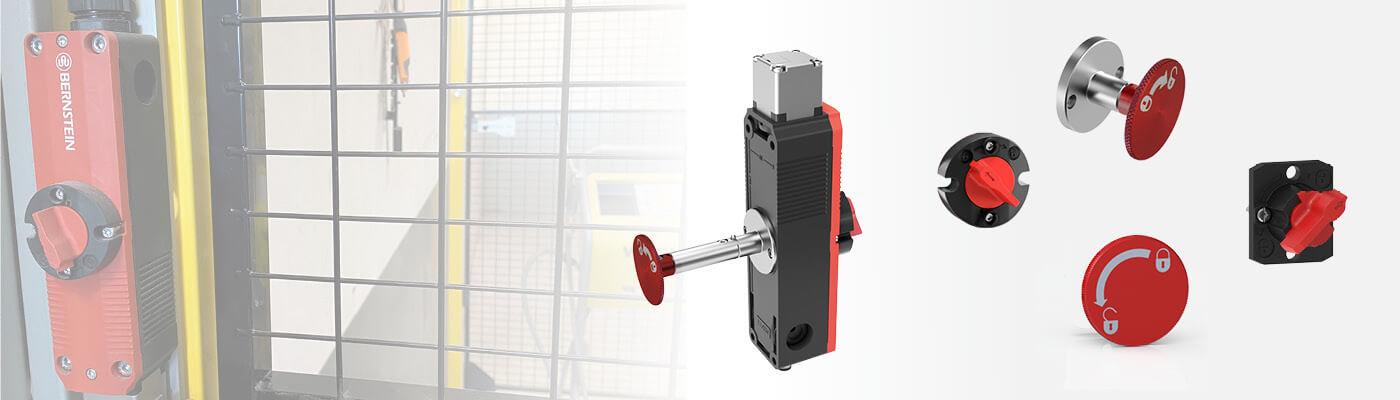
In automated machines, safety switches with guard locking prevent safety doors from opening as long as there is a hazard. But what happens in exceptional cases when a person is in the interlocked safety zone or a door needs to be opened in the event of a fault? Escape release and emergency unlocking ensure that safety is guaranteed even under special conditions.
This article explains the differences, the technical implementation and the relevant requirements for standard-compliant planning of industrial safety interlocking devices and solenoid interlocks.
Topic overview
1. A comparison of the safety functions
2. Functionality and designs in practice
2.1. Video: escape release or emergency unlocking
3. When are escape release and emergency unlocking required?
3.1. When is an escape release useful?
3.2. When is an emergency release useful?
3.3. When is a combination useful?
4. Electronic safety switches with guard locking as an integrated solution
When locked safety gates need to be openedA comparison of the safety functions
In industrial plants, safety gates are often equipped with one or more safety switches with guard locking. This form of safety gate interlocking prevents opening as long as dangerous movements have not come to a complete standstill.
However, there are situations in which an interlocked safety gate must be opened deliberately - for example, if a person is in the protected area or if the door cannot be released normally due to a malfunction.
Two different safety functions are provided for these exceptional cases: escape release and emergency unlocking. Both intervene in special situations, but differ in their purpose and application.
Functionality and designs in practice
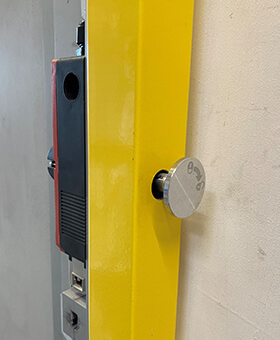
Escape releases and emergency releases differ not only in terms of their purpose, but also in terms of their design implementation.
Depending on the application, purely mechanical solutions or electronic safety switches with guard locking are used, which are additionally monitored or integrated into the safety control system.
In this video, our expert Sascha uses typical industrial applications to show you how these variants are constructed and how their practical implementation differs.

When are escape release and emergency unlocking required?
Whether an additional safety function is required can only be clarified as part of a risk assessment of the machine. The key questions here are: Can people enter the protected area and what happens when the door is locked?
The specific requirements can be found in EN ISO 14119 for interlocking devices and in the safety assessment in accordance with EN ISO 13849 as part of the Machinery Directive.
When does a combination make sense?
In many industrial plants, both functions are interlinked.
Whenever people can enter the protected area, safe self-exemption must be guaranteed. At the same time, it may also be necessary to open the door from the outside in a controlled manner in the event of a fault. In these cases, a single solution is often not sufficient.
Particularly in larger or complex systems with several access points, the combination of emergency unlocking and escape release creates a consistent safety concept for people in the protected area as well as for service or rescue situations from outside.
Electronic safety switches with guard locking as an integrated solution
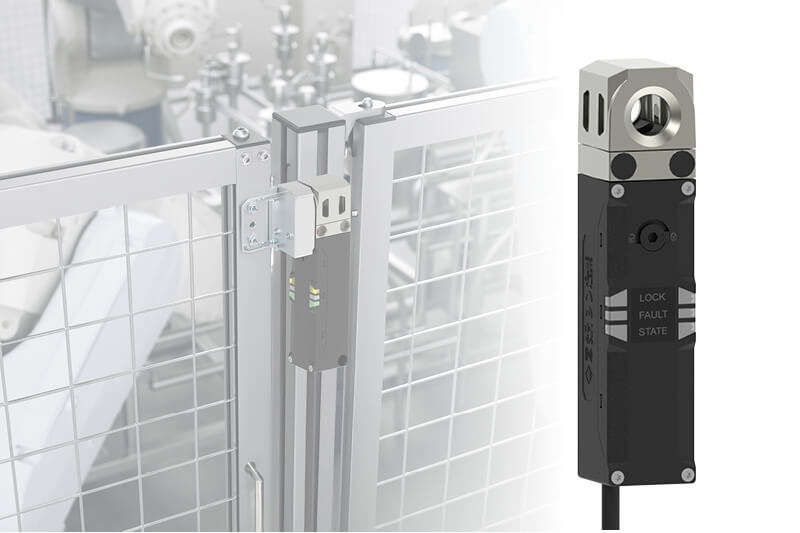
In addition to classic mechanical designs, electronic solenoid interlocks are increasingly being used today.
They represent a modern form of safety gate interlocking and combine a high locking force with integrated monitoring of the door and locking status.
This design offers particular advantages in complex systems:
Statuses can be diagnosed, tampering made more difficult and several safety gates can be integrated into a higher-level safety concept.
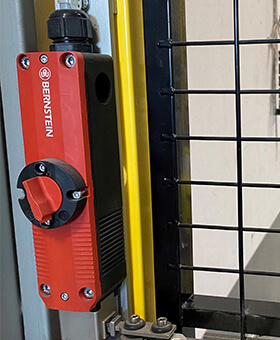
One example of such a solution is the SLO electronic safety switches with guard locking with RFID coding, high locking force and optional escape function.
It achieves performance level e and is particularly suitable for automated systems with increased requirements for tamper protection and diagnostic capability.
The exceptional case decides on safetyConclusion
A locked safety gate protects against dangerous movements, but can itself become a risk in exceptional cases. This is precisely when it becomes clear whether the safety concept has been considered holistically.
Escape release and emergency unlocking are not just additional options, but targeted solutions for situations in which the regular procedure has been interrupted. For example, if there are people in the protected area or if a door is not released in the event of a fault.
It is therefore crucial to consider these scenarios at an early stage in the risk assessment and to design the safety gate interlocking system accordingly - taking into account the relevant standards such as EN ISO 14119.
Safety does not end with the interlocking of a safety gate - it begins where the exceptional case is also considered.